Lajos Vermes is one of the most prominent figures in the history of sport in this region. Numerous records and historical facts testify to his dedication to sport, portraying a man who invested all his time, enthusiasm, money, and passion into promoting it. At a time when physical culture and sports disciplines were not as popular or widely followed as they are today, this nobleman revived the cult of sport. Instead of waiting for the Olympic Games to be revived, he conceived and organized them himself in Palić as early as 1880. years. Lajos Vermes held 35 sports titles and was a multiple champion of Subotica as well as other European cities. In competitions he won 16 trophies, 250 medals, 120 diplomas, and 140 laurel wreaths.
Wishing to continuously preserve the memory of one of the most important figures of Palić, we spoke with his direct descendant – Mihalj Vermes, a retired professor of mathematics. What follows in the remainder of the text is his story about the renowned Lajos Vermes.
We would like to thank Mr. Vermes for granting us access to his personal archive and family photographs published in this text.
Photo: Mihalj Vermes, grandson of Lajos Vermes
Lajos Vermes (Hungarian: Nagybudafalvi Vermes Lajos, 28 June 1860 – 22 May 1945) was born into a wealthy landowning family. His love for sport was inherited from his father Nándor, a participant in the Revolution of 1848. years. Vermes’s father was a lawyer and the founder of the Hunting Society in Subotica. He was also active in the then aristocratic and modern sports, such as horse racing and dog racing.
Photo: Ferdinand Vermes, around 1878. years
Lajos Vermes attended the Piarist Gymnasium in Budapest from the age of 10 to 18, where Latin and Greek were studied. As a younger student, he began practicing gymnastics at the National Gymnastic Society. He was inspired by the ancient Olympic Games and by Hellenic culture in general. 09.12.1877. At the age of 17, he won first place in the country in the gymnastics discipline of the pommel horse, which was also his first medal. From that moment on, sport and competition shaped the rest of his life’s path.
Sport became his life’s goal and meant everything to him – just like Palić. As contemporary newspapers wrote, he received much from sport, but he gave much, much more.
In the Subotica newspaper “Napló,” under the title “The Sower of Subotica’s Physical Culture,” he gave an extensive interview at the age of 76, in which he expressed a charming romantic thought:
“In my earliest youth I became engaged to sport and remained its eternal admirer.”
He traveled throughout the country, organized competitions across the region, and founded sports clubs. Besides gymnastics, his favorite sports were wrestling, weightlifting, and boxing, while in athletics he particularly enjoyed the long jump, high jump, and running events. Nevertheless, his greatest passion was cycling. 1878. When he returned from Pest, he brought one with him, and thus Subotica received its first bicycle.
Two years earlier he had traveled to Naples (Sicily) in order to take measurements of a discus from the original statue – Myron’s “Discobolus” (Discus Thrower). Based on these measurements, he cast a discus made of iron with a diameter of 220 mm (with two-thirds sharp and one-third blunt edge), and in this way the first discus arrived in Subotica.
Riding his bicycle – which he called the “iron horse” – he undertook long journeys across the country, participating in both shorter and longer competitions. He was attracted to innovations and even to extreme challenges, performing various acrobatics on the bicycle. He also enjoyed fencing, polo, and other sports, both as an organizer and as a competitor.
Photo: Lajos Vermes on a bicycle, Subotica, 1880. years
Sports Games of 1880 – 1914. Inspired by the ancient Olympic Games, he came up with the idea of organizing sports competitions on his estate in Palić, later known as the Palić Olympics – a name that Vermes himself never used.
He was the initiator, organizer, patron, active competitor, and a great missionary of sport and physical culture.
Dr. Branko Mrkić, professor and director of the Faculty of Physical Culture in Novi Sad, a well-known researcher of the history of sport, wrote the following in his university textbook from 1975 entitled “The Palić Sports Games”:
“The Palić Olympics in the period from 1880. – 1914. “…can rightly be called the golden age of sport, because such sporting events were organized in Palić that were noted by the entire sporting public. At these competitions, many of the most renowned athletes of Europe of that time took part, and competitors from the territory of Vojvodina demonstrated top-level results for the first time.”
His sporting philosophy, which the Vermes family proudly emphasizes today, was expressed in the following words:
“Sport must be accessible to every person and must be an integral part of everyday human life.”
At that time, this was undoubtedly a bold, progressive, and democratic idea – or, as it might be described today, “modern European thinking,” especially considering that sport in that era was largely a privilege reserved for nobles and the wealthy.
Photo: Wrestling scene, Lajos Vermes with students in Cluj, 1899. years
Photo: Boxing scene, Lajos Vermes with students in Cluj, around 1900. years
Precisely because of this idea and its implementation, dissenting voices could also be heard from Pest, speaking of him with subtle condescension for competing with “ordinary” people.
This sentiment can also be found in the book by Dr. László Siklósi from 1929:
“In the 1880s, Lajos Vermes was a true ‘all-around’ athlete of his time, the most characteristic sporting figure. Regardless of some of his unusual traits, he was the most ardent agitator for sport in Hungarian sporting history. Unconcerned with the realities of life, he was a man entirely driven by enthusiasm, a kind of hypertrophy of passion, who rushed along the road of life like a Greek flaming torch, spreading the glory of sport, of his homeland, and of his beloved Palić and Subotica.” Competition Vermes, together with his brother Nándor, who was two years younger, his cousin Béla, who was four years younger, and their friend Nikola Matković, founded the first gymnastic society. As members of this club, they began organizing the Palić Sports Games in the spirit of the ancient Olympic Games. The first games were held on August 26, 1880.
This means that the Olympic spirit found fertile ground in this region and developed here 16 years before the revival of the modern Olympic Games was even considered.
The first competition was very modest and included only three disciplines: wrestling, long jump, and shot put. The following year there were six disciplines, and by 1882 there were already three separate gymnastics events. Each year the games expanded with new sports, gradually developing into international competitions attended by thousands of spectators. Special trains were introduced for visitors, and the sports games soon became the main attraction of Palić.
The organization of the Palić Sports Games was a pioneering undertaking, since at that time the revival of the modern Olympic Games had not yet been contemplated. In some disciplines there were no official rules, so the organizers created them themselves, and from today’s perspective some of them appear quite unusual.
For example, one of the events was the pentathlon, organized in the traditional Greek manner with original equipment, along with discus and javelin throwing, running, long jump, and wrestling. In the javelin and discus throws, not only the distance was measured—the competitor also had to hit a target. In shot put, both the distance and the height of the throw were evaluated. In boxing, the winner was not determined by knockout but, similar to fencing, by scoring a touch.
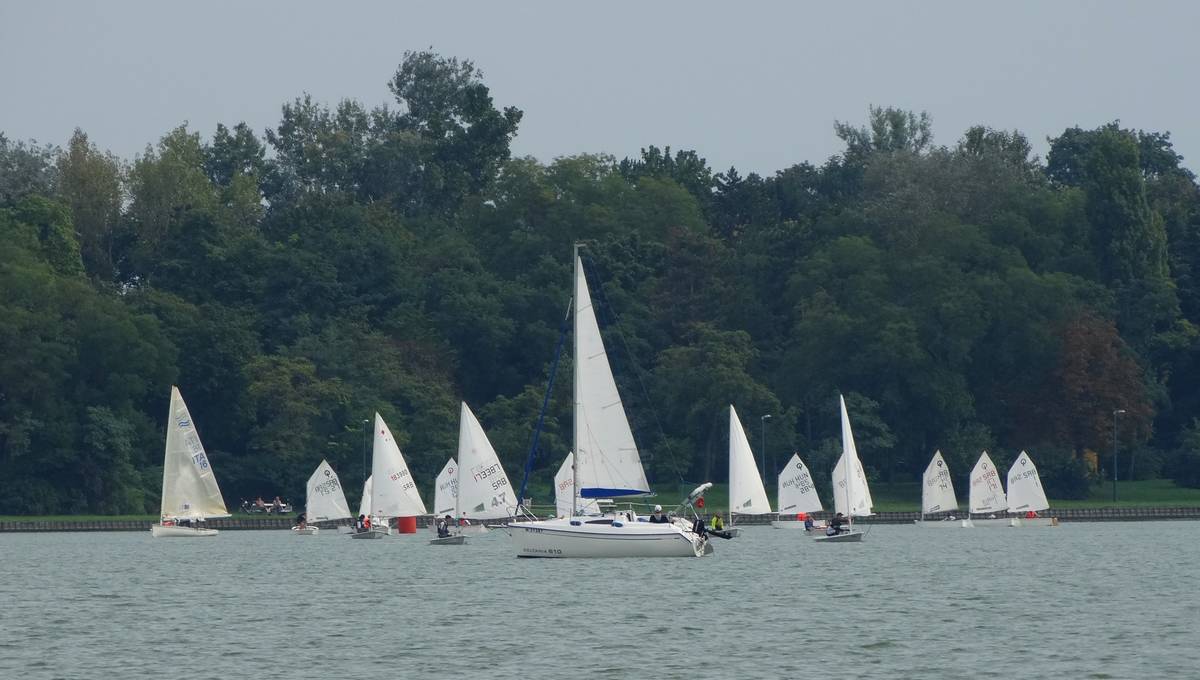
In obstacle swimming competitions, logs were placed along the course in Lake Palić, while bicycle races with obstacles were organized from Palić to Subotica and back. There were also events such as high jump, long jump, and pole vault, where competitors jumped using a trampoline. Another unusual discipline was sailing competitions on the frozen surface of Lake Palić.
Medal winners were richly rewarded, and sporting competitions in Pest and Vienna were scheduled so as not to overlap with the Palić Games, since the best athletes were known to participate there. At the end of the competitions, grand balls were organized.
In professional literature, the Palić Sports Games are recognized as a precursor to the modern Olympic Games. They had a significant influence on the development of sport and physical culture in Subotica, which by the end of the 19th century earned the nickname “the city of sports.”
The competitions attracted a large number of visitors from other regions, which stimulated the development of tourism and encouraged people to build magnificent villas in Palić. This in turn contributed to the strong urbanization and overall flourishing of the area.
An interesting fact from that time, less known to the public, is that a code of amateurism was defined, with strict criteria determining who could be considered an amateur athlete.
In 1894, the French aristocrat Pierre de Coubertin, founder of the Olympic movement, convened a meeting at the Sorbonne in Paris to establish the Olympic Committee with the aim of organizing the first modern Olympic Games in Athens in 1896. An invitation to this event was also sent to the Subotica Gymnastic Society, but Vermes—the most famous sports figure of that time—considered it more important to continue organizing his own sports games and therefore did not attend.
Constructed facilities
At the beginning of 1884, Vermes built an elliptical athletic track on his estate in Palić, with a circumference of 225 meters. Around it he constructed spectator stands known as the “Closed Arena,” which was the first of its kind in what was then Hungary. 1892. In that same year he built a sports hotel, the so-called “Owl Tower” (Bagolyvár) with 60 beds, where competitors had free accommodation—described by local media as the first Olympic village.
In the same year he also constructed an asphalt bicycle track of elliptical shape with a circumference of 500 meters, the third of its kind in Europe (after England and Germany).
These two investments cost him one million forints, while for comparison, the annual salary of a civil servant at that time was only about 300 forints.
The construction project on the shore of Lake Palić was a major undertaking, since the lakeshore itself was muddy, and it was necessary to bring in huge quantities of earth to fill and stabilize the ground for building. 1891. In the same period, he built a temporary grandstand for spectators on the shore of the lake and even rented a boat on which Greek tragedies were performed, featuring actors from Pest.
In addition to the Owl Tower, he built a villa for his mother called “Luiza.” Both villas still exist today. For himself, he constructed the so-called “Vermes Villa” on the site of today’s Eco Center, while the present-day “Riblja Čarda” (Fish Inn) once served as a gymnasium hall.
The celebrated and sadly late actress Mira Furlan, during her visit to the Palić Film Festival, where she once served as the president of the jury, stayed in Palić precisely in the famous Villa Luiza. She spoke only in praise of the villa, comparing the entire atmosphere to something that could be seen only in Hollywood in the United States.
Local newspapers in 1894 wrote that on Vermes’s estate in Achillon (the Home of Athletes) there were 15 facilities serving the purposes of accommodation, dining, and sport. Because of the large number of visitors attending the sports games, Vermes came up with the idea of establishing tram transport between Subotica and Palić, but this undertaking ultimately led him to bankruptcy.
A lesser-known fact is that the building located at 9 Ferenc Raichle Park in Subotica also belonged to him, but due to financial difficulties Vermes was forced to sell it to his uncle.
After his financial collapse in 1895, he accepted an invitation from Cluj, where he became a professor of gymnastics at the university named after Emperor Franz Joseph. In Cluj he married and had three children, remaining there until 1914, when he returned with his family to Palić. That same year his son Mihalj Vermes was born, the youngest of Vermes’s four children.
In 2016, the Hungarian Olympic and Sports Museum published a study titled “The First Hungarian Sports Photographer.” It states that Vermes ran a sports photography studio, not for commercial purposes, but solely to promote sport.
Vermes also designed a machine with a special device capable of turning a still image into a moving one—the first of its kind in Europe after America.
Photo: Long jump, photographed by Lajos Vermes, around 1880. years
Cooperation between the Palić Sports Games and Belgrade began in 1884, when three competitors from Belgrade—two clerks and one merchant—took part in the Palić Games, immediately joining both the sporting events and the forums of the games.
During his engagement in Cluj, in 1898, Vermes received an invitation from the Serbian royal court to become a fencing instructor to the young King Alexander Obrenović. Vermes enthusiastically accepted the invitation and spent six weeks at the royal court as a fencing instructor.
A gilded sabre engraved with the inscription “King Alexander” is today kept in the City Museum of Subotica, where it represents an important part of the museum’s collection of arms and military equipment.
Photo: Fencing scene, Lajos Vermes in Cluj, 1900. years
21. On July 22, 1900, an interesting sporting visit by athletes from Subotica to Belgrade took place under the patronage of King Alexander. According to the announcement of the visit, the guests paid for their own train transport to Novi Sad, after which they continued by boat to the port in Belgrade. They were accommodated in the former Hotel “Paris.”
A total of 40 competitors traveled to Belgrade, including four women. On that occasion, the athletes from Subotica introduced football to the large Belgrade audience—something that would surely be a surprising fact today for the famous players of Red Star and Partizan.
That evening, the king hosted a banquet, during which Lajos Vermes and Nikola Matković demonstrated their fencing skills by dueling with Belgian representatives of the sport.
Great Figures of the Palić Sports Games The Vermes brothers—Lajos, Nándor, and Béla—were exceptionally skilled and versatile athletes, and both of Lajos’s brothers helped in organizing the sports games. Nikola Matković was an excellent athlete, a gymnastics teacher at the gymnasium, and a highly respected coach. In 1900, at a major athletics meeting in Pest, he surprisingly won first place together with participants from the local gymnasium. Emperor Franz Joseph personally congratulated Matković on this great success.
Under the auspices of the Palić Sports Games, several renowned athletes emerged who would later spread the fame of Subotica’s sport throughout the country and the world. Among them were Đuro Stantić and the famous Ivan Sarić.
Đuro Stantić was an extraordinary sporting talent who distinguished himself in race walking at the end of the 19th century during the Palić Sports Games. His coach Nikola Matković, realizing the extent of his talent, began training him seriously. An interesting detail about Stantić is that at his first competitions he appeared wearing a civilian suit and boots, which caused considerable disapproval among the judges and spectators.
One of Stantić’s greatest successes came in Berlin in 1901, when he became world champion in the 75 km race walk, achieving the remarkable time of 8 hours, 16 minutes, and 24 seconds, meaning his average speed was close to 9.3 km/h. His greatest achievement, however, came on June 1, 1906, at the Intercalated Olympic Games in Athens, where he competed in the 3000 m race walk. His success was personally congratulated by the King of Greece, and thus the first Olympic medal arrived in Subotica.
Ivan Sarić practiced athletics but achieved his greatest success in cycling. After his outstanding results in several disciplines at a competition in Belgrade, he received congratulations from King Alexander himself. He was also an excellent football player, and in 1910 he became the first person in the Balkans to fly in an airplane of his own construction. A model of this aircraft is now displayed in the Museum of Aviation in Surčin. The city of Subotica honored him by naming its technical secondary school after him.
Mihalj Vermes, the son of Lajos Vermes, and Ivan Sarić worked side by side for many years in the administration of the city of Subotica. Thanks to this connection, many lesser-known details about Vermes’s life were preserved from Sarić’s perspective, reflecting his great respect for Vermes’s life and achievements.
Gustav Šimoković, a well-known wrestler, national team member, coach, and mentor of many veteran wrestlers—including Olympic and world champions who won numerous medals and brought fame to their country and to Subotica—learned his first steps in wrestling from Lajos Vermes himself. Šimoković later coached Sreta Damjanović, a world champion, while Damjanović in turn coached Davor Štefanek, Serbia’s Olympic champion.
Gustav Šimoković was also the father of the poet and writer Marija Šimoković, the author of the lyrical novel “Mr. Vermes’s Bicycle.” About the creation of her work she wrote:
“Vermes is a personality whose life contains both the biography of a city and the biography of good intentions. What fascinated me about him was the unity of the good, the beautiful, and the wise—that kalokagathia which was so Greek, Hellenic, and Olympic.”
For his contributions to the development, popularization, and mass participation in sport and physical culture, for his progressive sporting philosophy, his significant role in the construction of the tramway and sports facilities, and his contribution to the cultural and social flourishing of the city, Subotica paid him a special tribute. In 1936, during the Berlin Olympic Games, at the age of 76, he ran through the city center carrying the Olympic torch.
An interview once given by Vermes ends with the following sentence:
“Once I was a very wealthy man. I spent a great deal of money on sport. In Palić I built an asphalt bicycle track, and that track gave me the idea to build a tramway to Palić. Now I have nothing—only my health and something else,” he said, pulling from his pocket and showing a lifetime tram ticket that he had received from the tramway company.
Photo: Lajos Vermes with his family, Palić, 1931. years
An interesting personal detail about Lajos Vermes is that he kept a kind of diary about his family tree, in which he recorded various information about the members of his family.
Lajos Vermes passed away on his daughter’s estate in Bački Vinogradi at the very end of World War II, on May 22, 1945, in the period after the departure of the occupying forces and before the arrival of the liberators. He was buried at the Baja Cemetery in the Vermes family mausoleum built in 1906. years.
The Palić Olympics were revived in 2000, when the 120th anniversary of their founding was marked. On August 26 of the same year, a memorial plaque was unveiled next to the “Riblja Čarda” as a reminder of the former asphalt track— the third in Europe—built in 1891 for cycling and athletics competitions. 31.07. 2004. n the same year, a life-size bronze monument to Lajos Vermes was erected on the lakeshore, facing Lake Palić, next to the Owl Tower, which he had once built to accommodate participants of the Palić Olympics.
For the past 15 years, the Lajos Vermes Medals have been awarded to the best athletes of Subotica, while the promenade along the shore of Lake Palić now bears the name Lajos Vermes Promenade in his honor.
Photo: Monument to Lajos Vermes, erected in 2004. godine